Month: August 2008

  • Last Tweak

    See that homemade banner on your right? That was what kept me busy this weekend. A few mails, a few comments, and a lot of GTalk s gave me a feeling that the two sets of audience don’t necessarily like the ‘other’ type of content that appears on the site. So I have decided to shift the ‘brants’ content to its own separate space within the site.

    And therefore, those who wish to get only the personal blog content can continue with this feed, and those who like to read my take on brands and social media can check out the other space, and add one more feed. For the ‘only brants’ readers, I’m sorry for coming up with new feeds every fortnight, I promise not to inconvenience you further. ๐Ÿ™‚

    until next time, last tweak, for quite sometime ๐Ÿ˜‰

  • Herbs and Spice

    We’d already been to the first version, a couple of streets off CMH Road, and while it had a Euro cafe setting complete with a blackboard menu, we weren’t convinced enough to visit again. But when we heard there was a revamped version elsewhere in Indiranagar, we thought we should drop in.

    The new version is on 80ft Road, right at the junction of 12th Main and 100 ft Road, above Planet M. The ambience is definitely better here, and there are comfortable seating options for large and small groups. The menu is considerably more than the old version, and offers a more complete spread, including a variety of salads, main course, and desserts. There’s beer too!! If you’re going later than 8 pm, you might like to reserve, since it was quite crowded.

    We were however, disappointed, with the absence of a non-veg soup. So we started with a cream of broccoli soup, which after a by-two division turned out to be only a very small quantity. This was to be a recurring theme. To be fair, they did give us some breads, on the house.

    For the main course, we ordered a ‘Fusilli with chicken, bell peppers, mushroom and basil pesto’ and a ‘Grilled whole Indian salmon with a cherry tomato sauce’. I don’t know if it had anything to with the fish or the Indian part of it, but it took them 40 minutes to serve us. And unfortunately, it really wasn’t worth the wait. The fusilli with chicken was quite okay, and flavoured well, but the fish was a disaster!! A sacrifice both the fish as well as us could’ve done without. The quantity was meagre, and in a long time, I actually left a restaurant with a ‘nowhere near full’ stomach. Well, I did sulk and avoid dessert, but the quantity, or rather, the lack of it, had really put me off.

    They made us wait quite a bit for the bill. Pretty dumb, since there were at least two groups waiting for a table. All of the above cost us over Rs.800, which was just way too much for what we got.

    Photos at Zomato

  • Communities and Brandstreams

    Last week, I’d written about transparency in organisations, and touched upon something that’d force transparency on them – conversations about them. While conversations can happen on the organisation itself, I believe the brand will also act as a starting point in many conversations. A transparent organisation will transfer some positive equity to the brand and vice versa. What comes first is a good chicken-and-egg question. Whether they can exist independent of each other is also a good thought.

    Since I have written on organisations, I’ll veer towards the brand this time. There is a good article here on what brands should consider before jumping into the ‘create communities’ game. But then, brand associations should never be restricted to communities, it can be as basic as listening in on conversations that happen not just on the brand itself, but the specific and generic categories it belongs to.ย  Moreover, communities don’t need to be very rigid in the way they operate. Check out Dell’s efforts here. The second half of this article also succeeds in conveying this fabulously. In a convenience driven, information overloaded consumer’s mind, it is difficult for the ‘four times a year’, ‘when we feel we have to communicate something’ TVC-print-outdoor campaign that many brands follow, to find a place.

    So, what are brands doing? From small businesses that give ‘prewards‘, to FMCG giants that attempt buzz marketing, everything is being tried. Some succeed, and some are questioned. What the last link, Nike shows is that brands cannot escape now with lip service. They have to be true.

    Which brings me to possibilities. Quite sometime back, I’d read this post about user generated advertising and product wikis, a sort of the brand’s lifestream, if you will. I found it a very refreshing thought, even thought Heekya (via Mashable) might be a good tool to start the journey, and was happy to read a tangential postย  here. Please note that, though the second article uses ‘brandstreaming’ it is more to do with engaging the community through social media. Its still interesting though.

    But the best read I saw on this subject would be this post by Chris Brogan. I think it offers a great way for brands to balance their ‘official’ presence online with all the user generated stuff that’s bound to exist. But I’d still say community building has to start at home, i.e. organisation.

    until next time, start your brandstream..

  • Collage

    After a really long time, I chanced to see some college kids in action. Some, would be an understatement since it involved half a dozen colleges and a few hundred students. As part of the program, I got to see them in their natural environment, their college. Did that make them sound like animals? Okay, it wasn’t supposed to. It made me think about youth. Not mine, since my memory isn’t too good these days, but the usage of that word to represent the collective.And i realised it doesn’t really do them justice.

    For I saw dreamers, the silent types who sat in the corners of the college quad with either eyes glued firmly to a book, or absorbing the world around in general, sometimes with an amused smile.

    I saw the show-offs, displaying everything from the latest in gadgets and fashion, to the latest in body art, and equating that in some way with what and who they are.

    I saw the absolute rascals, whose single focus was the other gender, and their attention. From what i saw, I thought it was more hormones than nobler intentions of love.

    I saw escapists, who learned very early, that it doesnt matter if the grass is green on the other side, or any damn side, you still gotta have it, the grass that is.

    I saw those who were full of life, participating in all the contests that were happening, eager to prove, not to anyone else, but to themselves, that they had what it took to excel.

    I saw some who had perhaps given up on all that happened around them, some of them with a quizzical expression and some of them trying hard to populate vacant smiles.

    I saw those whose looks had more than a trace of rancour, was it against what they were surrounded by, who they were surrounded by or was it against those who were happy in these surroundings?

    Youth, the collective term for a population that consists of individuals who are perhaps still trying to find out who and what they are.

    And as i sat watching them,ย  I saw some of them stare back at me, as though asking me how life goes, years after you’ve left college? Whether the world you are part of now, resembles the world you used to occupy then. And I would’ve liked to tell them that the world outside does change, but for better or worse, the world within can stay exactly the way it is, if you’d let it. And that perhaps is why some of us never grow up, and some of us feel that we grew up a long time back. And both of these have nothing to do with our age.

    until next time, growing up…

  • Virtual Fourth Estate

    A few articles that have to do with newspapers caught my attention in the last couple of weeks. One was the fact that Instablogs, is doing something I desperately wished it would do – opening the network for external blogs. I personally consider Instablogs a good benchmark for what online news sources should be,ย  going forward. If you haven’t checked out Instablogs yet, now would be about time!!

    The second was an article on whether we need editors anymore. That question would be quite controversial in any case, but it helps when The Guardian asks this. It is quite a compelling read, and makes some telling points, on how editors should evolve in the digital era. I think that it also points to a mindset change in the newsroom and the presentation of news, because the way news is consumed is also changing. “Reporting becomes a process more than a product” and thats a fundamental shift in the way newspapers approach the business. Here’s a great read on the subject. It is sad to see how newspapers, with some of the best resources, are not able to channel it to better use on the internet. This is a perfect example for what I’m trying to say. Now, once you’ve thought about all this, check out Instablogs’ tour. It might explain why I find the site awesome.

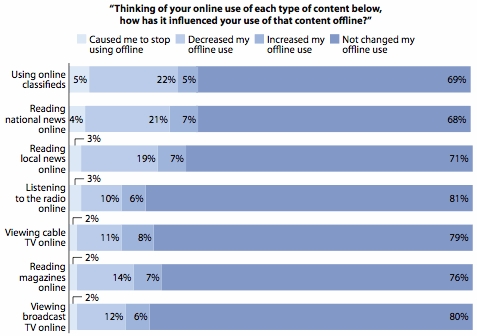
    Why is it important for newspapers to address the digital mindset issue? This data, (via here) though pertaining to the US shows how blogs and the online medium in general is making inroads into what was till now, the newspapers’ domain.

    While, with a 4.5% penetration, newspapers aren’t exactly on a ‘near-death spiral’ in India, I believe it still might be just a matter of ‘when’ rather than ‘if’. Speaking of which, the last article I wanted to discuss was one on WATBlog about Indiatimes’ launch of Hotklix, a Digg like service. Like I commented there, it would’ve been a great way for TOI, ET and all the publications of the Times Group to showcase the loads of content that they possess. How about seeding articles on a daily basis? Where is the integration of the TOI, ET websites with Hotklix, where I can bookmark an article immediately after I read it?

    On an aside, there are traditional news networks doing some pretty cool things on the web. CNN, for example, is allowing users to embed videos in blogs social media etc. No, that’s not a newspaper, I know, but it does come under ‘traditional media’. But even CNN received some flak a couple of weeks back. CNN is present on Twitter, and I happened to see this article, where a few users got pissed off with them for spoiling their Olympic fun. But that doesn’t stop the mashups. Take a look at Dialogg, their collaborative effort with Digg.

    Given that newsprint costs are rising, all over the world, and people are increasingly raising an uproar over cutting down of trees, I think its about time that newspapers took a long hard look at how the digital medium is transforming the content landscape. After all, we even have sanskrit newspapers going online. By digital, I don’t mean just the web, it could be the mobile too. 9.22 million subscribers have been added this month. I would like to compare it with the circulation additions for newspapers. Meanwhile, just read about an effort – MeraMobi, by the Dainik Bhaskar group in association with Pitroda Group LLC.

    Traditional media, especially newspapers, world over, have painstakingly created an equity and trust factor that’s extremely relevant in a transparency and trust led digital era, it would be sad to see it wasted. After all, with increasing global warming fears, newspapers might soon occupy the space that furs occupy now, so it might make sense to hunt for some virtual fourth estate.

    until next time, read….online? ๐Ÿ˜‰