Month: April 2008

  • The Source

    Each one of you felt an urge to write, and thats why you have a blog. You would have seen bloggers older than you, no not in age, like me, but those who have been around longer than you have. In turn they would also know bloggers older than them, but how did it all begin? I came across a picture recently on an egroup, that throws light on this. So, without further ado here it is.


    Now, like all answers, it poses a few questions of its own. Are we to understand that bloggers basically evolved from missionary positions? Does that also mean that perhaps female bloggers originated from nuns? most importantly, has there been any evolution since this image?

    until next time, seek and ye shall find

  • Interesting Times

    All my favourite sites absolutely trashed Indiatimes’ attempts at social networking – ITimes. I didn’t log into the site myself, and I doubt if i will, until either something drastic happens to facebook or itimes brings in such a revolutionary feature that it totally blows me out of my stasis. And from what I read in the Contensutra article, that has not happened, at least not yet. To be fair, though the reviews have been scathing, I saw some comments at Contentsutra, which gave iTimes a chance.

    I’m sure the Times group will soon launch a blitzkrieg to promote the site through print, radio, mobile, Indiatimes which pretty much covers media options. Oh, okay Times OOH, Zoom, Times Now also, happy? The possibilities are endless, from using social media as a platform to fight serious issues (and campaigns like Lead India) (Read this) to building Bollywood/fashion based communities based on Zoom content and everything in between. The only snag is how much of good integration have we seen with the existing properties?

    The WATBlog post mentions how internationally, its usually the tech guys who build web properties and the big media guys come in later. I think it has a lot to do (sigh, again) with interent access. The internet has been adopted by the mass there, and they can actually build a brand on the web. But lack of penetration here means that either the techies need huge pockets and backing (eg.Ibibo – Naspers) or they have to wait for a looong time for the critical mass – revenues. The alternate scenario is happening where a media company has the money and the media (reach) to promote a web property. The problem, i guess is when they use existing/sub standard resources, and apply learnings from other media, which just won’t work.

    In the larger picture, remember that HT bought Desi Martini, so we might see the same players fighting on a different platform. And so, while it does sound like an Apple platform for news sharing, we’re in for some interesting times.

    until next time, whats next twitimes? 😉

  • The future of the Internet in India

    is mobile. That’s a feeling I’ve been getting for quite sometime. Take a look at the figures

    Internet – 46 million according to the iCube report 2007

    Mobile – 250 miilion, according to TRAI

    I read two articles today which pushed me in this direction. One was Indiagames’ new mobile distribution deal, and the other was TringMe opening up its API for developers. While the first supports the title of the post, the second might seem contra, but i feel the development will happen more on the mobile front.

    From a consumer standpoint, i see a convenience factor. While I am more a web fan than a mobile one, the sheer fact that i always have my mobile with me as opposed to my broadband connection explains the accessibility parameter. Yes, the amount of stuff i can access, and the small screen are deterrents, but i feel its a matter of time before that gets resolved. And yes, Facebook’s on Blackberry too, so…. 🙂

    From a brand point of view, while the net does give a filtered reach, the population which would use the net on mobile would be just as filtered. Most of the stuff being done on the net, from vanilla contests to rich applications, I’m sure can be adapted to the mobile platform. And what better platform for a brand than an always on consumer’s mobile? Unlike the net, I can push stuff onto the consumer (all those malls now proclaim ‘Bluetooth Zone’. I dont think they’re aiming at my laptop, maybe because i wasnt carrying it?)

    A convergence will happen, and for now, unless broadband suddenly starts coming out of taps, in India, it sees like the offspring will look more like a mobile than a comp. Wht d u thnk?

    until next time, mob justice?

  • Paradox

    There are times, usually on those starlit nights, when one realises the insignificance of his own self in the context of the cosmos’ vast expanses. But then one sees events around him, considers his own actions, the effects it has on others, and the butterfly effect that starts from then on, and realises his significance.

    until next time, signatures in the annals of time

  • Social Icing

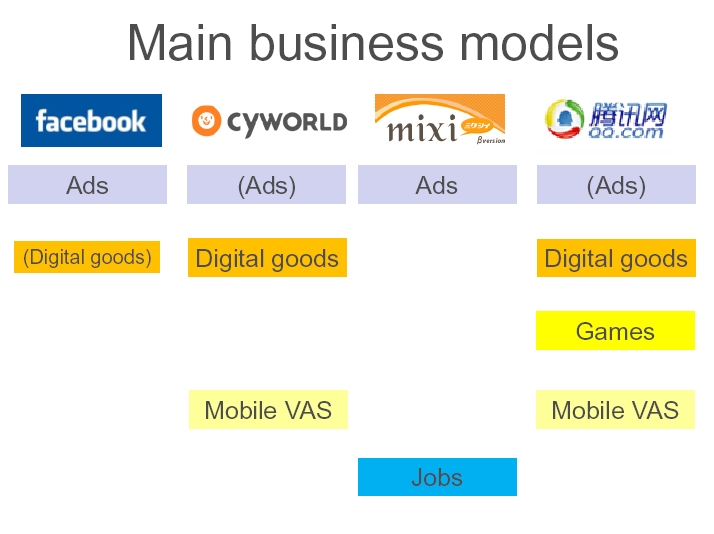
    Continuing from what i wrote earlier, the social networks we’re familiar with (assuming you don’t use our friendly neighbourhood sites – cyworld, qq, mixi) have a revenue mix of ads and virtual goods. However, as the chart below will show you, this is not the only way to monetise a social network, as the chart below will show you.

    clipboard01.jpg

    Courtesy – http://www.plus8star.com/ 

    Now, should that make our familiar networks hmm, disoriented? :D. Not exactly, because the population is there, even if its lesser than the other sites. The word of caution, is that the audience reaction to monetisation can never really be predicted.

    Social media is indeed popular, though it is felt that it lacks metrics which are so important for monetisation.That however, has not stopped brands from using the networks in a variety of ways. From making groups to building applications and so on, brands have cashed in on the network’s popularity to hook the customer on one more platform. This, for example is a post on social media marketing strategies.

    The common newspaper ad sales motto is that they lease their relationship with their customers to paying third parties. While the digital scene has diverged from traditional media in a lot of ways, I’m not quite sure why this can’t be made true for social media. I agree that a lot of applications are also a value addition to the site since they keep the visitors glued, but that can’t be the case always.

    For instance, look at this application on Facebook by Coca Cola. I doubt if Facebook is making any money from Coke. But the basic questions are ‘Whose platform is Coke using?’ and ‘Whose audience is Coke using?’. And so, why can’t this be a way for Facebook to make money? By all means, allow developers to make applications, but if brands are involved, no harm in asking them to pay. Use part of the revenues to keep users happy by providing better features. That’d be the icing.

    until next time, socialism 2.0