
Category: Life Ordinary

  • A plan to be

    One of my first posts this year was Certain, simple frames, in which I had written about my lapse-of-reason episodes, and my methods of overcoming them. I had also mentioned in the post the insight I got about myself – the lapses of reason were triggered by my fear of it upsetting the plan. The Plan is financial freedom for D and me – we shouldn’t have to work for the sake of earning for current or future needs and wants.

    In this context,  I found a quote by Ramit Sethi that succinctly conveyed a perspective that I have touched upon in at least a couple of my posts – Prisons of Happiness (conscious choices of freedom and understanding the trade offs) and Please Find Detached (on delaying stimuli and minimising lifestyle creep) – a rather distinct definition of frugality.
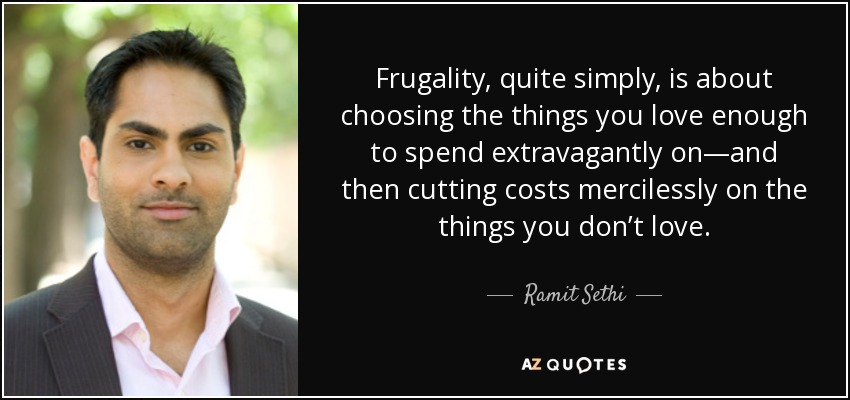
    quote-frugality-quite-simply-is-about-choosing-the-things-you-love-enough-to-spend-extravagantly-ramit-sethi-64-20-74

    I have been doing this for a while, but the catch, as I have experienced, is in “choosing the things you love enough”, and it exists because of the intent behind that ‘love’. The usage of the word “love” is important. In my view, it is used to distinguish the things that one really wants.

    But it is difficult to be objective about one really wants. Paradoxically, at different points, the intent could be a desire to belong, or a desire to stand out. A fundamental human need to connect and share that drives the first. A basic ego stokes the second. A desired destination here could be a kind of “reflective equilibrium”. Easier said than done!

    The ego first derives from societal benchmarks, the projected self, and then self image. Getting beyond the last one is extremely tough. And if one does get close, there is an immediate realisation that there are no markers, no play books, no goals. There is no unseeing this either. “And once you are awake, you shall remain awake eternally. ”All very difficult to get used to, especially when the mind continues to ask, “Is it going to be ok?”

    To quote Bill Bonner, “There’s the standard of living, which can be measured in dollars, and there’s the quality of your life, which can’t be measured at all.The Plan is built on financials, and is therefore aimed at tackling the first part. The second is indeed an intangible, and speaks probably of a contentment that comes from being comfortable with one’s decisions. That’s why the plan is also an attempt to iron out the terms of one’s interaction with the world, and just be. The hope then, is that belonging will take care of itself because one is actively pursuing the wants that really matter, without money having a real say in it. The desire to stand out? Well, it will be forced to sit out!

  • MeMo

    It’s been a while, but that’s the way it always has been with us. I am posting this on a day when I know I’d have heard from you. Some years you’d call, some years you’d WhatsApp, and the last couple of years, you took to Twitter just so you could needle me.

    Twitter was our playground. We had our own language, I remember people getting irritated by it! I was always in awe of you, and your sublime words and ideas. It didn’t begin on Twitter though, it began with a comment on a blog. But it did end on Twitter, and it speaks about how out of touch I was, that I got to know when someone added me to a conversation.

    On that day, many people reached out to me, asking me if I was ok. I was, but I wasn’t, and ironically, I felt you’d be the only person who could understand what I was going through.  But I went through the motions – I tweeted about you, retweeted those posts about you, and signalled normalcy. (more…)

  • Regression planning

    During our reindeer sledding tour in Tromso last year, our guide, who was a Sámi, gave us a glimpse of their way of living. A semi-nomadic life, built around their reindeer herds, which involved them traveling for several days twice a year across hundreds of kilometres. She told us how the capture and nurture of reindeers, and the lifestyle itself, has changed from a means of livelihood to a tradition that only very few are interested in.

    In Fahadh’s movie Njan Prakashan, there is a hilarious, yet poignant moment, when he is asked to help the other workers plant rice seedlings in a field in Kerala. The workers immediately start off and are soon singing in gusto. Fahadh, who has never done any of this before, stands with his mouth agape, and then asks what the language is! His boss explains how most of the paddy field workers in Kerala now are Bengalis, and they’re singing their customary song. “We’ve forgotten our job, we’ve forgotten our song“, he says (roughly translated). (more…)

  • Certain, simple frames

    I read an article recently on decision making, which among other things wrote about how instinct could beat analytical thinking. An insightful heuristic that I found in it was this – ..if you are in an uncertain world, make it simple. If you are in a world that’s highly predictable, make it complex.

    While the article focused on decision making in the business context, I could relate to it in the personal context. I see the world at large as an uncertain and complex place, and have spent a lot of time in the last few years trying to contain its influence on my own life. It has been an evolution. The expectations frame  I have written about does a fairly good job of reducing the variables, but it isn’t perfect. There are people and events that frustrate me, I sometimes lose my cool, and my remorse later doesn’t really change anything for anyone, including me. (example) (more…)

  • Objectivity, and the path to joy

    Sometime back, a colleague and I had a conversation on retaining objectivity during decision making. I felt that if one does not do that in life generally, it won’t happen at work either. We live in our narratives, and the brain, after all, is only so flexible.

    That led to a train of thought. Objectivity (also) comes from being able to step out and get a view of one’s self from outside. Insights into one’s self can happen all the while, if you allow it. Two recent incidents to highlight this. (more…)